Thursday, 18 August 2022

Thinking Activity : Midnight children

Introduction :- 


Sir Ahmed Salman Rushdie[a] FRSL (born 19 June 1947) is an Indian-born British-American novelist and essayist.[3] His work, combining magical realism with historical fiction, is primarily concerned with the many connections, disruptions, and migrations between Eastern and Western civilizations, with much of his fiction being set on the Indian subcontinent. 

About Midnight’s Children :- 

Midnight's Children is a 1981 novel by author Salman Rushdie. It portrays India's transition from British colonial rule to independence and the partition of India. It is considered an example of postcolonial, postmodern, and magical realist literature. The story is told by its chief protagonist, Saleem Sinai, and is set in the context of actual historical events. The style of preserving history with fictional accounts is self-reflexive.

Midnight's Children won both the Booker Prize and the James Tait Black Memorial Prize in 1981.[1] It was awarded the "Booker of Bookers" Prize and the best all-time prize winners in 1993 and 2008 to celebrate the Booker Prize 25th and 40th anniversary.[2][3] In 2003, the novel was listed on the BBC's The Big Read poll of the UK's "best-loved novels".[4] It was also added to the list of Great Books of the 20th Century, published by Penguin Books.

 1) Narrative technique ( changes made in film adaptation - for eg. Absences of Padma the Nati the listener the commenter - what is your interpretation?) 

In the movie ‘ Midnight’s Children’ so many changes had been made by the director. So many characters are not included and there is also a slight change in narrative technique also. In the original text the story is told by the protagonist himself and the story is listened to by Padma. This technique is connected with Bharatmuni’s ‘ Natya Shastra. It means here Saleem is Nat and Padma is Nati. In film adaptation this method is changed and here Saleem tells the story but the audience plays the role of nati.

However, in the novel the preceding chapters to Tick Tock are told in retrospect and Saleem’s abundance of stories make it difficult, not only for the reader, but also for the naïve narratee Padma, to follow his jumps in time and space, as well as his many other digressions. After journeys that have brought Saleem to Pakistan, Bangladesh and Delhi, he retires when he has rediscovered his ayah Mary Pereira in his childhood city, Bombay. She now owns a pickle factory and is able to provide him with whatever he needs, and he has the time and opportunity to pickle his memory and write down the story of his life. The setting in the pickle factory where Saleem recounts his stories are said to be a parallel to the frame story of Arabian Nights. This isevidently an intertextual element used to make suspense both in Arabian Nights, also famous as One Thousand and One Nights, and in Midnight’s Children. But in the film the character of Padma is missing, so the responsibility to understand the situation comes over the watchers. So we can see some threats in the film.  

2) Characters ( how many included how many left out why ? What is your interpretation? 

These are the main characters. Satya Bhabha as Saleem Sinai, Shriya Saran as Parvati, Siddharth Narayan as Shiva, Darsheel Safary as Saleem Sinai (as a child), Anupam Kher as Ghani, Shabana Azmi as Naseem, Neha Mahajan as Young Naseem, Seema Biswas as Mary, Charles Dance as William Methwold, Samrat Chakrabarti as Wee Willie Winkie, Rajat Kapoor as Aadam Aziz, Soha Ali Khan as Jamila, Rahul Bose as Zulfikar, Anita Majumdar as Emerald, Shahana Goswami as Amina, Chandan Roy Sanyal as Joseph D'Costa, Ronit Roy as Ahmed Sinai, Kulbhushan Kharbanda as Picture Singh, Shikha Talsania as Alia, Zaib Shaikh as Nadir Khan, Sarita Choudhury as Indira Gandhi, Vinay Pathak as Hardy, Kapila Jayawardena as Governor, Ranvir Shorey as Laurel, Suresh Menon as Field Marshal, G.R Perera as Astrologer. 

In the opening scenes we can observe differences in the way the versions address the audience: the novel’s narrator uses the first person to provide, in a deferred and roundabout way, his story; in the film, there is also direct speech, but the narrative proceeds much more unswervingly. The other two versions do not construct a rapport with the audience in such a straightforward way by direct address. In movie, the audience is shown both the historical background on screen and the event of the twin births on stage. Only after these opening scenes does the narrator step in, either as a voiceover or as a character onstage. 

The novel and the film thus seem to initially create a more personal rapport with their constructed audiences. It is significant in this respect that the character of Padma, the novel’s original immediate addressee and audience the person who listens to and comments on Saleem’s narrative, and the second main character in the novel, after the protagonist is included in the first two adaptations, but in the film she is supplanted by Rushdie’s voiceover. 

Padma’s role in the film was originally offered to the actor Nandita Das, who had worked with Mehta in Fire and Earth, but Das abandoned the project for personal reasons. Rather than looking for a substitute for the role of Padma, this setback was compensated by introducing the voiceover. The choice has been regarded variously as a success and a failure by critics, for example, from the gender perspective. There are indeed grounds for interpreting the substitution of a female voice with a male as problematic; this change may even be attributed to the authorial ego.  

3) Themes and symbols ( if film adaptation able to capture themes and symbols ? ) 

The Silver Spittoon :-

The silver spittoon given to Amina as part of her dowry by the Rani of Cooch Naheen is responsible for Saleem’s loss of memory. Even when he has amnesia, however, Saleem continues to cherish the spittoon as if he still understands its historical value. Following the destruction of his family, the silver spittoon is the only tangible remnant of Saleem’s former life, and yet it too is eventually destroyed when Saleem’s house in the ghetto is torn down. Spittoons, once used as part of a cherished game for both old and young, gradually fell out of use: the old men no longer spit their betel juice into the street as they tell stories, nor do the children dart in between the streams as they listen. The spittoon is the symbol of a vanishing era, which, in retrospect, seemed simpler and easier. And so, although Saleem may not be able to recall the specific association between the spittoon and his family, the spittoon maintains its symbolic quality as both a container of memory and source of amnesia.

Knees and nose 

Saleem Sinai’s large, bulbous nose is a symbol of his power as the leader of the Midnight Children’s Conference, which is comprised of all children born on the moment of India’s independence from British rule. His nose makes his power of telepathy possible, and this is how he communicates with the other children of midnight (who all have varied powers of their own). Saleem inherits his rather large, and perpetually congested, nose from his grandfather, Aadam Aziz, who also uses his nose to sniff out trouble. Saleem’s nasal powers begin after an accident in his mother’s washing-chest, in which he sniffs a rogue pajama string up his nose, resulting in a deafening sneeze and the instant arrival of the voices in his head. Saleem’s power of telepathy remains until a sinus surgery clears out his nose “goo.” After his surgery, Saleem is unable to further commune with the other children. Ironically, after Saleem’s nasal congestion is gone, he gains the ability to smell emotions, and he spends much time categorizing all the smells he frequently encounters.

Pickle :- 

Pickles are repeatedly mentioned in Midnight’s Children, and while they are often viewed as a phallic symbol, they are generally representative of the power of preservation within Rushdie’s novel. Saleem is the manager of a pickle factory, and he preserves pickles and chutneys each day. He also attempts to preserve his own life story like the pickles in his factory. Saleem largely manages to preserve his life through storytelling, offering a bit of immortality to a dying man, and he also labels and stores each chapter he writes in a pickle jar, so that they may be read later, by his son for example. This connection between pickles and the preservation of stories endures until the very end of the book, when Saleem ceremoniously labels his very last pickle jar as a way of closing out his story and his life as a whole.

4 ) The texture of the Nobel ( what is the texture of the novel ? Well it the inter connectedness of narrative technique with theme is it well captured ? )  

 We see the good attempt by Salman Rushdie and Deepa Mehta. The film is not told in chronological order, but it is told in flashback. When Salim remembered something he told the audience and listener. And then come back to real life from that flashback. Whole story is told by Salim. And he described the things that he felt. This is my interpretation of the novel and film adaptation. Well some symbols are used very closely in some movies, like Taj Mahal. But Salman Rushdie and Deepa Mehta haven't took very close up scene of Taj Mahal. That we can see in the movie, 

5) what is your aesthetic experience after watching the screening ? 

This movie tries to show what the situation was like with imagination and history. Speaking against politics was a big challenge. Emergency was imposed by Indira Gandhi at that time. It was not an easy task but writing such a novel in the face of politics at that time was a big challenge. Which Salman Rushdie has done. Salman's midnight children novels have become very popular. This novel tells the same story but the way of telling the story changes. we can say that it was great combination of various scenes. I recommend you to read the novel. I have suggest to possible watch the movie. You will surely enjoy and learn many things from this movies. 

Thank u...

Thinking Activity : Foe by J. M.Coetzee

J.M. Coetzee 


J.M. Coetzee, in full John Maxwell Coetzee, (born February 9, 1940, Cape Town, South Africa), South African novelist, critic, and translator noted for his novels about the effects of colonization. In 2003 he won the Nobel Prize for Literature. 

Foe by J.M. Coetzee

Foe is a 1986 novel by South African-born Nobel laureate J. M. Coetzee. Woven around the existing plot of Robinson Crusoe, Foe is written from the perspective of Susan Barton, a castaway who landed on the same island inhabited by "Cruso" and Friday as their adventures were already underway. Like Robinson Crusoe, it is a frame story, unfolded as Barton's narrative while in England attempting to convince the writer Daniel Foe to help transform her tale into popular fiction. Focused primarily on themes of language and power, the novel was the subject of criticism in South Africa, where it was regarded as politically irrelevant on its release. Coetzee revisited the composition of Robinson Crusoe in 2003 in his Nobel Prize acceptance speech. 

Questions and Answers  :- 

1) How would you differential the characters of Cruso and Crusoe

In Daniel Defoe’s novel, Robinson Crusoe, the novel portrayed as a foundational text to early fictional writings and introduced writers as well as readers to having a narrative in an island setting. Within Defoe’s novel, one is able to get a glimpse of the stereotypical gender roles from the 17thcentury because patriarchy reigned supreme. Women were property while men were authoritarians. The novel is shown through the eyes of a middle-aged white male during colonization. Crusoe “owns” the islands and instructs those living there just as if he were the “governor” or political leader-just as any British colony would be governed. By this, the reader is able to see through the eyes of Robinson Crusoe about the issues of not only gender but with race and independence. Although Robinson Crusoewas written in the early 1700’s, a more recent novel by J.M. Coetzee called Foewas an artistic piece that imitated Defoe’s well-known work. Even though the two novels share many similar aspects, Coetzee framed his work to provide an updated perspective of the story Defoe had composed by adding in the presence of a woman figure, incorporating a new setting, and more modernistic viewpoint.

2) Friday's characteristics and persona in foe and in Robinson Crusoe. 

Probably the first nonwhite character to be given a realistic, individualized, and humane portrayal in the English novel, Friday has a huge literary and cultural importance. If Crusoe represents the first colonial mind in fiction, then Friday represents not just a Caribbean tribesman, but all the natives of America, Asia, and Africa who would later be oppressed in the age of European imperialism. At the moment when Crusoe teaches Friday to call him “Master” Friday becomes an enduring political symbol of racial injustice in a modern world critical of imperialist expansion. Recent rewritings of the Crusoe story, like J. M. Coetzee’s Foe and Michel Tournier’s Friday, emphasize the sad consequences of Crusoe’s failure to understand Friday and suggest how the tale might be told very differently from the native’s perspective. 

3) who is protagonist ? ( Foe - Susan - Friday - Unnamed narrator) 

Cruso is adapted from Robinson Crusoe, the protagonist of Daniel Defoe's famous novel. He has long moved past any semblance to Defoe's character by the time he is introduced to the narrative. Susan tries to extract information from Cruso but notes that his memories are scattered and unreliable. Any version of Defoe's Crusoe that once existed has been replaced by Cruso and his empty terraces and empty mind. Whereas Defoe's Crusoe was a younger and more sympathetic figure, Coetzee's character is older and more stubborn. He is the lonely king of his pitiful domain. Coetzee's Cruso is a beguiling character. He wages war against apes that pose no apparent threat. He is struck down by mysterious fevers. He builds terraces but can not plant any gardens. He bullies and cajoles Friday but welcomes Susan into the camp without hesitation. He shouts at Susan but agrees to make her shoes. In a fevered state, he sexually assaults Susan and never mentions it again. Susan nevertheless finds Cruso's story compelling. Even after he dies she wants to tell the story because she recognizes the lingering traces of goodness in Cruso's character. The realization that Cruso is more antagonist than protagonist makes sense of Cruso's story. Susan begins to think about Cruso not as the central character in the story but as the master of Friday; Friday is the real protagonist. Cruso may be a slave owner, a torturer, and an abuser but his scattered mind and empty deeds neuter his past villainy.

Thank you 


Sunday, 17 July 2022

Thinking activity : Derrida and Deconstruction

 Hello my dear friends

I am Nehalba Gohil and a student of M.K. Bhavnagar University department of English. We have talk about Deconstruction and deconstruct any advertisement text movie and serial.

Jacques Derrida 


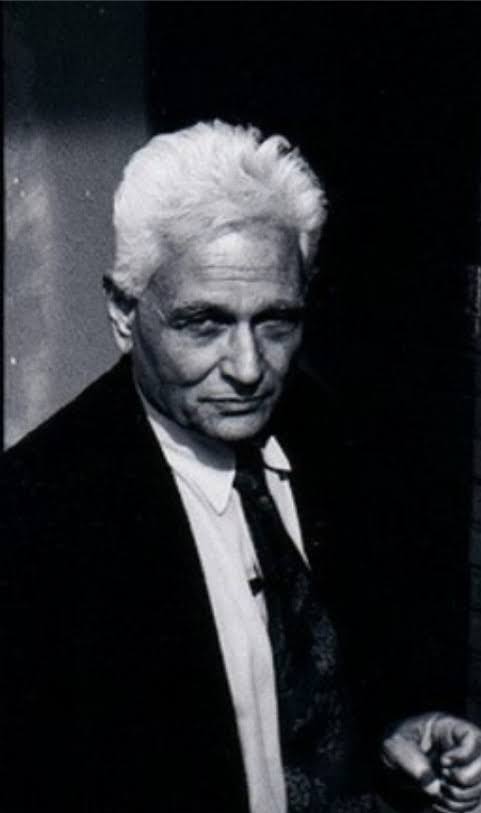
Jacques Derrida is a French philosopher, was born on July 15, 1930 in Algiers of Algeria, the then French colony. He is famously known as the father of Deconstruction. He has published more than 40 books on various topics such as anthropology, sociology, semiotics, jurisprudence, literary theory and so on. Some of them of “Grammatology” is very famous one that discusses theory of deconstruction and its various aspects. Jacques Derrida was the founder of “deconstruction,” a way of criticizing not only both literary and philosophical texts but also political institutions. Although Derrida at times expressed regret concerning the fate of the word “deconstruction,” its popularity indicates the wide-ranging influence of his thought, in philosophy, in literary criticism and theory, in art and, in particular, architectural theory, and in political theory. Derrida died in Paris on October 8, 2004. 

Jacques Derrida first read his paper Structure, Sign and Play in the Discourse of Human Sciences (1966) at the John Hopkins International Colloquium on “The Language of Criticism and the Sciences of Man” in October 1966 articulating for the first time a post structuralist theoretical paradigm. This conference was described by Richard Macksey and Eugenio Donata to be 

Derrida embraces this decentred universe of free play as liberating, just as Barthes in 'The Death of the Author' celebrates the demise of the author as ushering in an era of joyous freedom. The consequences of this new decentred universe are impossible to predict, but we must endeavour not to be among 'those who ... turn their eyes away in the face of the as yet unnamable which is proclaiming itself (Newton, p. 154).   

Definetion of Deconstruction :-  

A philosophical movement and theory of literary Criticism that questions traditional assumption about certainty, identity and truth; asserts that words can only refer to other words; and attempts to demonstrate how statement about any text subvert their own meaning. 

 what is Deconstruction?  

   If we define Deconstruction meaning so it is difficult to define exact meaning. Deconstruction is not destructive activity but an inquiry into the foundations so it is not negative term.

Jacques Darrida wrote a essay on structure sign and play in discourse of human science. When we talk about what Darrida say we found that in his career we found that he has question that how we can give proper definition of something. That is why he himself never gave definition of Deconstruction.

According to Darrida what we do is differentiating one thing from the other. And for this he gave word DifferAnce.    

According to M.H.Abraham’s ‘A Glossary of Literary Terms’... 

Deconstruction”, a applied in the criticism of literature,designes a theory and practice of reading that questions and claims to “subvert” or “undermine” the assumption that the system of language is based on grounds that are adequate to establish the boundaries, the coherence or unity,and the determinate meaning of literary text.Typically, a deconstructive reading sets out to show that conflicting forces within the text itself serve to dissipate the seeming definiteness of its structure and meanings into an indefinite array of incompatible and undecidable possibilities. 

DIfferAnce = to differ + to defer

Deconstruction means some event or play or anything but in which some loose point is there and it's became the Deconstruction. Than we can't find any particular meanning. In a way Deconstruction is not a term that destroys the meaning, but it gives us ideas to think differently.  

Good-bad

man-woman 

rich-poor

white-black

What do we understand about 'Deconstruction'? 

Deconstruction is an approach to understanding the relationship between text and meaning. ... Deconstruction argues that language, especially in ideal concepts such as truth and justice, is irreducibly complex, unstable, or impossible to determine.

If we can think about Deconstruction it means a new way of thinking. We can not particular emphasis on any words because we can get so many meanings from reading any text as a way of Deconstructive reading. So the meaning of Deconstructive reading is that of finding something new which is very Different to define.  

How to deconstruct a text ? 

Language bears within itself the necessity of its own critique. Do not naturalize what is not natural. Deconstruction insists not that truth is illusory but that truth is institutional.Deconstruction is a philosophical movement spearheaded by Ermch thinker Jacques Derrida and other critics during the 1960s.

As a literary theory, it focuses on exposing cultural lases in all texts, whether agamage in a popular book or the flashing script of a television ad

Readers engaged in deconstruction analyse words and sentences to identify inherent buses and call into question amonplace interpretations of the text. While this may sound presumptuces or cymical on the front end, deamstruction im't about destroying mening Rather, it's about undenining ingrained amimptions to view things in a new light Neuffe.

Deconstruction, as applied in the criticism of literature, designates a theory and practice of reading which questions and claims to "subvert" or "undermine" the assumption that the system of language provides grounds that are adequate to establish the boundaries, the coherence or unity, and the determinate meanings of a literary text. Typically, a deconstructive reading sets out to show that conflicting forces within the text itself serve to dimipate the seeming definiteness of its structure and meanings into an indefinite arrey of incompatible and undecidable posibilities "

First example : - 


This is actual advertisement of MDH masala. When we see this add first time we find that i Rajasthani culture in add so we imagine that it's about any kind of tourism ya family related add . But after when captions was coming than we find that it's about masala.  

Second example :- 


This movie is about the war between India and Pakistan. But it also deconstructs the idea about women in India as well as every woman. Generally we think that women are like dolls. She can’t do labor or hard work. In this movie that tradition is broken. Gujarati women helped the Indian air force to reconstruct the runaway within 24 hours. 

Conclusion :- 

Thus, Derrida still remain ambiguous and interesting face in literary theory. He suggests that to go beyond philosophy, it has to be read I “a certain way” not assume there is something beyond it. We cannot say what any sing means without reference to its relations to other signs. He employs term like trace / difference / differance / supplement to explain this indeterminacy or play. He also shows by the same logic that logocentrism or phonocentrism or ‘privileging speech over writing has no validity. Stanley Fish, Miller and Paul de man also gives their view to prove the idea of deconstruction. 

Thank you 

Monday, 11 July 2022

Thinking activity : R.K. Narayans An Astrologers Day

 Introduction :-  


The surrounding darkness seems to offer a refuge to the astrologer. There is an unexpected twist in the tale with the arrival of Guru Nayak on the scene. Gradually the mystery that is hidden in the darkness is unveiled by his questions. Guru Nayak challenges the astrologer’s knowledge. He refuses to go away without getting a satisfactory answer to his questions. 

However, the astrologer who is at his wit’s end now decides to face the situation. He displays accurate knowledge about Guru Nayak’s past and is successful in convincing him. In answering the question of Guru Nayak, the astrologer has not only deceived him but also saved himself from his own fate. The author superbly evokes the atmosphere of suspense and irony in the story. The story reveals how appearances are often deceptive. It shows the witty astrologer’s encounter and escape from his former enemy. 

Questions and answers :- 

1) How faithful is the movie to the original short story ? 

The plot of the story and movie is almost same . Characters & themes are also same in the both story . But we can find some scenes & characters are not described in the original text . 

2) After watching the movie have your perception about the short story characters or situations changed.?

Yes we find changes in the characters. because if we compare the both movie and story that one character of chutki who daughter of astrologer in short story but there is no mention of that kind of character in real short story.

And there is also a his wife character that not much described in short story as well as movie. 

3)Do you feel aesthetic delight while watching the movie? If yes exactly when did it happen? If no can you explain with reason?

Yes, I felt that delight while watching the movie. When he returns home after the meeting of gurunanayak and he felt that he did not murder. Luck by chance gurunanayak was allive. While talking of this incident with his wife we can see the comfortableness on his face. 

4) Does screening of movie help you in better understanding of the short story? 

Obviously yes. Because it can be said that 

A picture is worth a thousand words

It was good experience of watching the movies.Visuals are always better than reading.And this video was quite appropriate to the main plot.

5) was there any particular scene or moment in the story that you think was perfect? 

Yes there is the last ending of the story was perfect. R.k Narayan very significantly gave the ending of the story. That there is a some kind of regret felt protogonist in the last. And that's best scene I find in story which is well described by R.K.Narayan. That scene that he talk about his wife about his crime it was the perfect scene which I find. 

6) If you are director what changes would you like to make in the remaining of the movie based on the short story An Astrologers Day by R.K. Narayan? 

If I am the director of this movie I add Some more drama and some loudly musics and and also a one more clients like gurunanayak. And I

add some horrible elements and that murder night looks a horrific scene in story.

And I also add some more characters in the story and make this some little longer. 

Thank you  

Sunday, 10 July 2022

Flipped learning : Derrida and Deconstruction

 Introduction :- 


Jacques Derrida 

Jacques Derrida is a French philosopher, was born on July 15, 1930 in Algiers of Algeria, the then French colony. He is famously known as the father of Deconstruction. He has published more than 40 books on various topics such as anthropology, sociology, semiotics, jurisprudence, literary theory and so on. Some of them of “Grammatology” is very famous one that discusses theory of deconstruction and its various aspects. Jacques Derrida was the founder of “deconstruction,” a way of criticizing not only both literary and philosophical texts but also political institutions. Although Derrida at times expressed regret concerning the fate of the word “deconstruction,” its popularity indicates the wide-ranging influence of his thought, in philosophy, in literary criticism and theory, in art and, in particular, architectural theory, and in political theory. Derrida died in Paris on October 8, 2004. 

Jacques Derrida first read his paper Structure, Sign and Play in the Discourse of Human Sciences (1966) at the John Hopkins International Colloquium on “The Language of Criticism and the Sciences of Man” in October 1966 articulating for the first time a post structuralist theoretical paradigm. This conference was described by Richard Macksey and Eugenio Donata to be 

Derrida embraces this decentred universe of free play as liberating, just as Barthes in 'The Death of the Author' celebrates the demise of the author as ushering in an era of joyous freedom. The consequences of this new decentred universe are impossible to predict, but we must endeavour not to be among 'those who ... turn their eyes away in the face of the as yet unnamable which is proclaiming itself (Newton, p. 154). 

1 ) what is Deconstruction?  

        If we define Deconstruction meaning so it is difficult to define exact meaning. Deconstruction is not destructive activity but an inquiry into the foundations so it is not negative term.

Jacques Darrida wrote a essay on structure sign and play in discourse of human science. When we talk about what Darrida say we found that in his career we found that he has question that how we can give proper definition of something. That is why he himself never gave definition of Deconstruction.

According to Darrida what we do is differentiating one thing from the other. And for this he gave word DifferAnce.   

2) Difference = to differ and to defer the meaning 

DiffreAnce is not an idea or a concept but a force which makes differentiation possible which makes postponing possible.

He also talk about the idea of center. He gave the idea of decentering the center. According to Darrida "The center is paradoxically within the structure and out side it. The totality has its center else where The center is not the center. 


For Darrida it was necessary to began thinking there was no center, that center could be thought in the form of present being, that center has no natural site that it was not a fixed locus but a function, a short of nonlocus in which an infinite number of sign - substitution come in to play. This rupture this Deconstruction of the center thus created a world where " the absences of the transcendental signified extends domian and play of signification infinitely. " 

3)what makes content of Darrida's point of view?

We look for the truth of the text which in fact is only language, and create in our quest another text through our criticism to supplement the lack of the original text. Supplement the lack of the original text reading is reactivating the expressivity of the text with the help of its indicative signs. But in the words of John Sturrock,

the meanings that are read into it may or may not coincide with the meanings which the author believes he or she has invested it with. A reasonable view is that a large number of these meanings will coincide depending on how far separable author and reader are in time, space and culture; but that a large number of other meanings will not coincide. For language have powers of generating meanings irrespective of the wishes of those of who use it. 

4) why is it difficult to difine Deconstruction ? 

As applied in the criticism of literature, designates a theory and practice of reading which questions and claims to "subvert" or "undermine" the assumption that the system of language provides grounds that are adequate to establish the boundaries, the coherence or unity, and the determinate meanings of a literary text. Typically, a deconstructive reading sets out to show that conflicting forces within the text itself serve to dissipate the seeming definiteness of its structure and meanings into an indefinite array of incompatible and undecidable possibilities.

A post – structuralist term referring to the new way texts are read and interpreted. It is a view of literature derived from Jacques Derrida’s theory of writing and the linguistics of Saussure. Traditional interpretation of author and suppressed the kind of subjectivity, which is often interfered with it. Traditional interpretation also assumed that it is possible to get at the meaning of the text because it is universal.

This is based on a language philosophy which stress the relativity of meaning in as much as ‘language is a system of differences without positive terms.’ 

It was Saussure who showed that signs differ from each other and they become meaningful through their difference which often taken the form of opposition.For ex: The red is a traffic signal it means stop while green means go. The connection between the signifier red and the signified stop is arbitrary, conventional; It is defined not by its essential properties but by the difference that distinguishes it from green or other signs.  

5) Derridian rethinking on the foundation of western philosophy.

Derrida’s critique of Heidegger’s theory, he mentions that Heidegger also tried to look at language as speech and not as a whole tendency. So, he finds the play of ‘logocentrism’ which he calls ‘phonocentrism’. Derrida believes that if a speaker speaks whatever he intends than the intention is a logocentric theory of western philosophy of language. According to the philosophy of language, there is a metaphysics of presence, a presence of a transcendental signifier that holds its position in meaning. This way logocentrism is responsible for phonocentrism which is known as the Derridian rethinking of the foundations of Western philosophy. 

Conclusion :- 

Thus, Derrida still remain ambiguous and interesting face in literary theory. He suggests that to go beyond philosophy, it has to be read I “a certain way” not assume there is something beyond it. We cannot say what any sing means without reference to its relations to other signs. He employs term like trace / difference / differance / supplement to explain this indeterminacy or play. He also shows by the same logic that logocentrism or phonocentrism or ‘privileging speech over writing has no validity. Stanley Fish, Miller and Paul de man also gives their view to prove the idea of deconstruction. 

Thank you 

Saturday, 9 July 2022

Wide Sargasso Sea

 Jean Rhys :- 


Jean Rhys, CBE was a British novelist who was born and grew up in the Caribbean island of Dominica. From the age of 16, she was mainly resident in England, where she was sent for her education. She is best known for her novel Wide Sargasso Sea, written as a prequel to Charlotte Brontë's Jane Eyre. 


Wide Sargasso Sea :- 


Wide Sargasso Sea, novel by Jean Rhys, published in 1966. A well-received work of fiction, it takes its theme and main character from the novel Jane Eyre by Charlotte Brontë.

The book details the life of Antoinette Mason (known in Jane Eyre as Bertha), a West Indian who marries an unnamed man in Jamaica and returns with him to his home in England. Locked in a loveless marriage and settled in an inhospitable climate, Antoinette goes mad and is frequently violent. Her husband confines her to the attic of his house at Thornfield. Only he and Grace Poole, the attendant he has hired to care for her, know of Antoinette’s existence. The reader gradually learns that Antoinette’s unnamed husband is Mr. Rochester, later to become the beloved of Jane Eyre. 

Post colonialism :- 

Brontë’s work also demonstrates postcolonialism whereby Western culture is considered Eurocentric. This means that European values are universal and natural compared to Eastern ideas that are inferior . For instance, Bertha, a foreign woman, reflects the Eurocentric and dominant ideologies of England in the 19th century concerning race. Bertha is the racial other and colonized madwoman who threatens British men and women as embodied in Mr. Rochester and Jane. Jane presents Bertha Mason as Vampiric, who sucks away from Mr. Rochester’s innocence. According to Mr. Rochester, he was innocent until the savage woman took his goodness. Also, Jane, a British, cannot get married because Bertha has occupied the wife’s position, denying Jane’s identity. The situation shows how British people characterized and feared women and foreigners during postcolonialism. The fear was not because they thought the subjects were powerful, but because they considered them inferior and evil. The “blood-red” moon reflected in Bertha’s eyes represents her sexual potency, whereby Bertha refuses to be controlled. Her stature is almost equal to her husband’s. According to postcolonialism, Bertha’s death is meant as a sacrifice to restore British people’s superiority, whereby Mr. Rochester acquires freedom to marry Jane while Jane achieves her self-identity.

Further, in the postcolonialism era, men considered women to be their appendages Men would work, own business, and remain in public. However, only family life and marriage belonged to women. They had to depend on men spiritually, financially, and physically. For example, Adele and her mother demonstrate this idea, whereby they depend on Mr. Rochester for everything. Their dependence is further despised by the British people like Jane and Mr. Rochester consider them sensual and materialistic, characteristics associated with foreign women at the time.

The Wide Sargasso Sea novel also portrays irony as the author tries to describe the idea of postcolonialism. Rhys wants readers to realize that being a casted woman is demanding. Therefore, with Antoinette’s Creole character, individuals have to understand that they cannot change their inevitable, and thus they should accept events as they turn out.

Feminism :- 

Jane Eyre is a bildungsroman, a novel of personal development, loosely based on Bronte's own experiences, and drawing upon her extensive knowledge of folklore, her vivid imagination and her influences, including the Romantics (Rochester has been described as a 'Byronic hero') and Shakespeare. The novel is a masterpiece that arose from Bronte's intention to create a love story interwoven with her own experiences, even though her own life did not have such a fairy-tale-like ending.

Wide Sargasso Sea derives from Jane Eyre, and the relationship between the two has provoked much critical discussion about the two authors' intentions. The novels must be read together in order to fully appreciate how they complement each other, and how each is also a novel in its own right, with distinct characters and plot.

We can also compare the difference between how the symbolism of fire distinguishes the representations of Jane and Antoinette's characters. Rochester describes the West Indies as 'Fiery' and we see his dislike of this unfamiliar environment grow to overpowering proportions, until he decides to shoot himself. He is prevented by 'a fresh wind from Europe', which entices him home. This scene echoes Jane Eyre, where Jane hears Rochester's voice calling her back to Thornfield. Rochester undoubtedly associates Jamaica with evil and so Bertha's fiery, manic disposition fits in with his view of the Caribbean. England is seen as 'pure', Jane is described as having 'clear eyes' a 'face', this healthy description informing us of her mental health. Rochester wants a true English Rose 'this is what I wished to have' (laying a hand on Jane's shoulder). Bertha's fiery, hateful and wild nature is the opposite of Jane's prim and typically English reserve. The passionate nature at the heart of the novel is epitomised in Jane's metaphor for her love for Rochester, 'Fiery iron grasped my vitals'. Jane's fire is in her love whereas Antoinette's fire is one of pain and fear. Fire also links Jane to Bertha, both in passion and in the actual setting of fire, most notably the fire that kills Bertha but symbolises rebirth in the character of Rochester. 

Conclusion :- 

 in sum up we can say that one feature the novels have in common is that both authors make use of the literary device of symbolism in their writing. In both novels our appreciation of the characters and themes is enriched by the symbolism inherent in such narrative elements as dreams, visions, landscapes, characters' names, place names, colours, fire, and even the titles. 

Thank you 

Tuesday, 5 July 2022

ThAct : CS : Unit - 1

 Cultural studies 


It is difficult to difine this term. But some poststructuralism like Raymond William who would love to define it as everyday life as really lived by one and all including common men. It is a wide area for study cultural studies it it's scope of study. As it aims to transcend all disciplines and breaks the difference between the high and law the elite and the popular culture it encompasses almost everything under its umbrella.

If we discussing about the cultural studies than we should definitely talk about the power and media.

Power 


Definition of power

Power is the ability of its holder to make other individuals obedient on whatever basis in some social relationship 

In foucualts theories power is granted through knowledge and therefore constructs truth 

Now we will see that how power operate for that there are three laws of power :-

1) power is never static                                         2) power is like water :- power like a water that it's flow anywhere and spread in everywhere.      It's seems that policy is power Frozen                                                      3) power compound 

We talk about power so in that context I would like to talk about the one French post modernist Foucault and his theory on the power and knowledge. 


Foucault argued that intimately bound up so much so that that he coined the term power / knowledge to point out that one is not separate from the other ....In his most important works this included an analysis of texts images and buildings to map how forms of knowledge change                                according to Foucault that power is wielded by people or groups by way of episodic or sovereign acts of domination or coercion seeing it instead as disperses and pervasive Power is everywhere and  comes from everywhere so in this sense is neither an agency not a structure.    Foucault is one of the few writers on power who recognise that  power is not just a negative carecive or repressive things that forces us to do things against our wishes but can also be a necessary productive and positive force in society.       A key point about Foucault it's approach to power is that it transcends politics and sees power as an everyday socialised and embodied phenomenon. This is why State centric power struggle including revolutions do not always lead to change in the social order. For some Foucualts concepts of power is so elusive and removed from agency or structure that there seems to be little scope for practical action . But he has been hugely influential in pointing to the ways that horms can be so embedded as to be beyond our perception causing us to discipline ourselves without any wilful coercion from others.

                     Media

Why media studies is so important in our digital culture? 

The media and cultural studies (MCs) program emphasize the study of media in thair historical economic, social and political context we examine the cultural from created and disseminated by media industries and the ways in which they resonate in everyday life on the individual national and global level. Focusing primarily on sound and screen media film popular music radio video games but reaching out across boundaries MCs encourage interdisciplinary and teansmedia research.

Noam Chomsky has to say about Mass media . He gives five filters 

1)Media ownership :- 

Mass media firms are big corporations often they are part of even bigger conglomerates. Their end game ? Profit and so it's in their interests to push for whatever guarantees that profit . Naturally critical journalism must take second place to the needs and interests of the corporation.

2) Advertising

The second filter exposes the real role of advertising media costs a lot more than consumers will ever pay so who fills the gap advertiser's 

3) Media Elite 

The establishment manages the media through the third filters. Journalism cannot be a check on power because the very system encourages complicity . Government's corporation big institutions know how to play the media game.

4) Flack 

If you want to challenge power you 'll be pushed to the margin when the media journalist whistleblowers sources stray away from the consensus they get flack. This is the fourth filter when the story is inconvenient for the powers that be you'll see the flak machine in action discrediting sources trashing stories and diverting the conversation

5) The common Enemy 

To manufacture consent you need an enemy a target that common Enemy is the fifth filters communism  Terrorists  Immigrants a common enemy a bogeyman fear helps corral public opinion. 

Who can be considered as truly educated person? 

Now we all very well aware about the education and it's impact a true education opens a door to human intellectual freedom and creative autonomy.                      It not important what we cover in the class it's important what you discover. A true education opens a door to human intellectual freedom and creative autonomy it's not important what we cover in the class it's important what you discover . To be truly educated means to be resourceful to able to formulate serious questions and questions standard doctrine if that's appropriate it means to find your own way truly people try to come out from their knowledge to other people if he develops his Knowledge and skills in such a way which ultimately results into his positive contribution in community life acquiring Knowledge and using it for the happiness and goodness of the society really makes a person educated. Education person is always be a regional and reasonable.

Conclusion :- 

In conclusion power and culture are the foundation of the society. The cultural orientation of the people within a society or group determines thier definition of power and how they react towards those in authority power complement culture in the sense that it enforce cultural values and norms 

Thank you 


Assignment 210 Dessertation Conclusion

 Paper - 210 Name - Nehalba Gohil Roll no - 15  Topic :- Feminist Approach in Kamala Das's Poems  Enrollment no - 4069206420210009 Email...